Making sense of the slip
After an eye exam, your doctor hands you a slip of paper full of numbers and abbreviations. If you've ever stared at it with no idea what it says, you're in good company.
Here's what each value means.
OD and OS — which eye is which
- OD (oculus dexter) = your right eye
- OS (oculus sinister) = your left eye
- OU (oculus uterque) = both eyes, used when the values are the same
Each eye gets its own row on the prescription.
Sphere (SPH)
Sphere corrects nearsightedness or farsightedness:
- Negative (−) values mean you're nearsighted (myopic): close things look sharp, distant things look blurry.
- Positive (+) values mean you're farsighted (hyperopic): distant things may look clearer than close ones.
The number is measured in diopters. −2.00 is moderate nearsightedness; −6.00 or beyond is considered strong.
Cylinder (CYL) and axis
These two values work as a pair to correct astigmatism — an uneven curve of the cornea that blurs vision at certain angles.
- Cylinder is how much astigmatism correction you need, in diopters.
- Axis is the angle, from 0 to 180 degrees, where that correction is applied.
A blank or zero cylinder means no astigmatism. Plenty of people have mild astigmatism (CYL under −1.00) and may not notice it without correction.
Add power
The Add value — sometimes written "ADD" or "NV-ADD" — only appears on multifocal prescriptions, meaning bifocals or progressives.
It's the extra magnification you need for reading and close work, on top of your distance prescription. Add power is always positive, usually between +0.75 and +3.00.
No Add value means you need single-vision lenses only.
Pupillary distance (PD)
PD is the distance between the centers of your pupils, in millimeters. It's used to line up the optical center of each lens with your eye.
- Single PD: one number for both eyes, such as 63 mm. The average adult PD is 54–74 mm.
- Dual PD: a separate number for each eye, such as OD 31.5 / OS 32.0. This is more precise, since most faces aren't perfectly symmetrical.
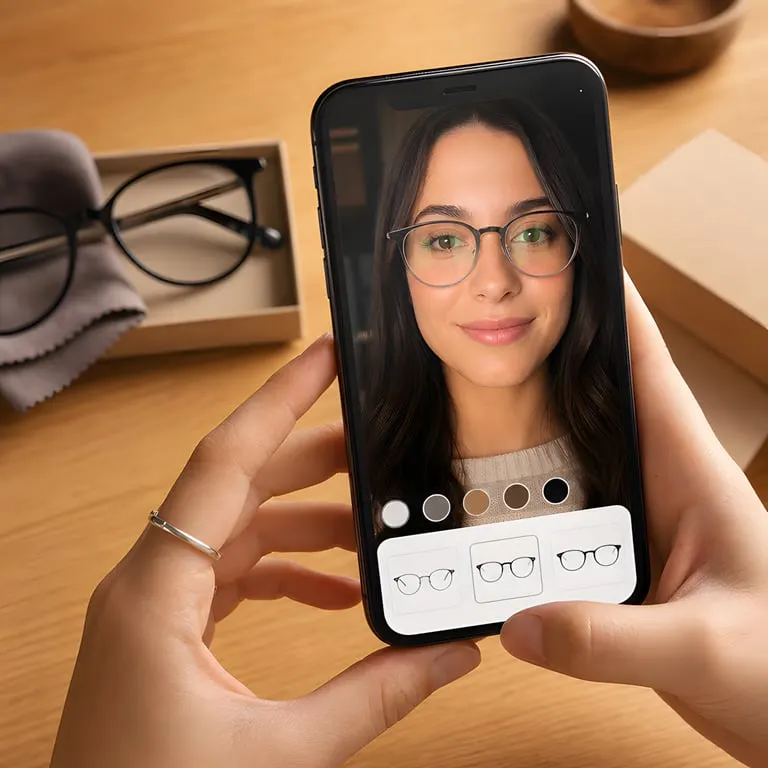
Your doctor may or may not write your PD on the prescription. If it's missing, you can measure it yourself with a ruler and a mirror, or with a camera-based tool.
When your prescription expires
In most US states, an eyeglass prescription is valid for 1–2 years from the exam date. The expiration date should be printed on it.
You can't legally order new glasses on an expired prescription; you'll need a new eye exam first.
Which lenses do you need?
Your prescription points to the right lens type:
- SPH only (no CYL, no Add) → single vision
- SPH + CYL (no Add) → single vision with astigmatism correction
- SPH + Add → bifocal or progressive
- SPH + CYL + Add → progressive with astigmatism correction
Tips for ordering online
Online, you'll enter your prescription exactly as written. Watch out for these:
- Don't swap OD and OS — right-eye values go in the right-eye fields.
- Keep the sign — sphere can be positive or negative.
- Axis is required whenever there's a cylinder — one doesn't appear without the other.
- Double-check the Add — an Add entered wrong will make progressives unusable.
Not sure about a value? Ask your eye doctor's office. They're required to give you a copy of your prescription and can answer your questions.