Most optical practices don't really have a handoff problem. They have a visibility problem.
A patient moves from the exam chair to the frame board, from frame choice to the lens conversation, from order entry to fulfillment, and from pickup to follow-up. Each of those moments usually works — but nobody has mapped them end to end. So the same friction keeps coming back: a measurement gets retaken, a lens decision gets reopened at pickup, a shopper leaves to "think about it" and never returns.
Mapping the handoffs around one patient visit is among the most useful things a practice manager or independent optometrist can do this quarter. You don't need new software, a consultant or a long staff meeting. You need to walk the path a patient actually takes, write down every transition, and ask who owns each step.
Here's how to do it well.
Map the transitions, not the tasks
When teams document their optical workflow, they tend to list tasks: verify insurance, perform the exam, take measurements, show frames, quote lenses, place the order. That list is useful, but it hides where the friction really is. Friction lives between tasks — in the moments when responsibility passes from one person, tool or system to the next.
An easy way to see those moments is to draw the visit as arrows instead of boxes. Each arrow is a handoff: exam room to optical floor, optician to lab, front desk to the patient's phone, the patient's phone back to your inbox. For a typical single-pair progressive sale, you may count anywhere from eight to fifteen separate handoffs, depending on how your practice runs. People are often surprised by that number.
Once the arrows are on paper, ask three questions at each one:
- Who is responsible just before this arrow, and who is responsible just after it?
- What information has to cross it — an Rx, a PD, a frame SKU, a lens choice, a benefit detail?
- What happens when that information is missing, wrong or late?
The third question is where the hidden rework shows up. A missing segment height brings the patient back. A misheard lens preference turns into a remake. A fuzzy benefit quote becomes an awkward moment at pickup. None of these is a disaster alone, but together they shape what your practice feels like to work in — and to buy from.
Trace one real visit from start to finish
Mapping in the abstract only goes so far. It gets much sharper when you pick a specific, recent patient and follow their real path. Use an anonymized case — say, a returning patient in for an annual exam who needed an updated progressive and chose a mid-tier frame — and rebuild the visit step by step.
A representative sketch might look like this:
- Patient checks in; the front desk confirms benefits and updates demographics.
- A technician runs pretesting; results go into the EHR.
- The doctor performs the exam and finalizes the Rx.
- The doctor or tech hands off to optical — "Sam will help you with frames."
- The optician reviews the Rx, lifestyle needs and current eyewear.
- The patient browses, tries several frames and narrows it to two.
- The optician takes measurements and talks through lens options.
- A quote is built, benefits are applied and the patient decides.
- The order is entered; the frame is pulled from stock or ordered in.
- The lab receives the job; lenses are made in-house or sent out.
- The frame arrives; QC and dispensing prep happen.
- The patient is notified and pickup is scheduled.
- Dispense: fit, adjust and explain how to adapt.
- A follow-up goes out after a set interval.
Now mark up that path in two colors. Use one color for every step where the patient had to repeat information or wait without knowing why. Use the other for every step where your team had to chase information from another person or system. Where the marks cluster is where to focus.
In most practices, three or four hotspots appear: the move from exam to optical, the lens decision, the order-to-lab handoff, and the gap between "your glasses are ready" and pickup. These are the moments where a deliberate, mapped workflow pays for itself many times over.
Split judgment work from mechanical work
With the visit traced and the hotspots marked, sort every step into one of two groups: steps that need trained optical or clinical judgment, and steps that simply move information around.
Judgment steps include tailoring lens recommendations to a patient's job, checking that a measurement makes sense for a particular frame, spotting an Rx that looks wrong, deciding whether a remake is justified, and reading the room during a benefits conversation. These belong with your team. Don't squeeze them or automate them away.
Mechanical steps include re-typing an Rx that already lives in the EHR, working out by hand what a benefit will cover, sending a "your glasses are ready" text, and copying a frame SKU into a lab order. This is where consistency, structure and better tools make the biggest difference — every minute saved here is a minute your opticians can give to the judgment work that sets your practice apart.
This split matters because it stops a common mistake: "streamlining" the wrong steps. Rushing the lens consultation usually backfires. Speeding up the paperwork around it nearly always helps.
Define what each handoff should feel like
Now you can describe what "good" looks like at each handoff. Practices often jump straight to tools here, but it's more useful to write down the experience standard first.
- Exam to optical: the optician has already seen the Rx and any relevant notes before the patient sits down, and the introduction happens by name, not as a cold restart.
- Notification to pickup: the patient knows within a set window when their eyewear will be ready, and the message tells them what to expect at dispense.
- Order to lab: the lab gets a complete job packet the first time, with no follow-up calls.
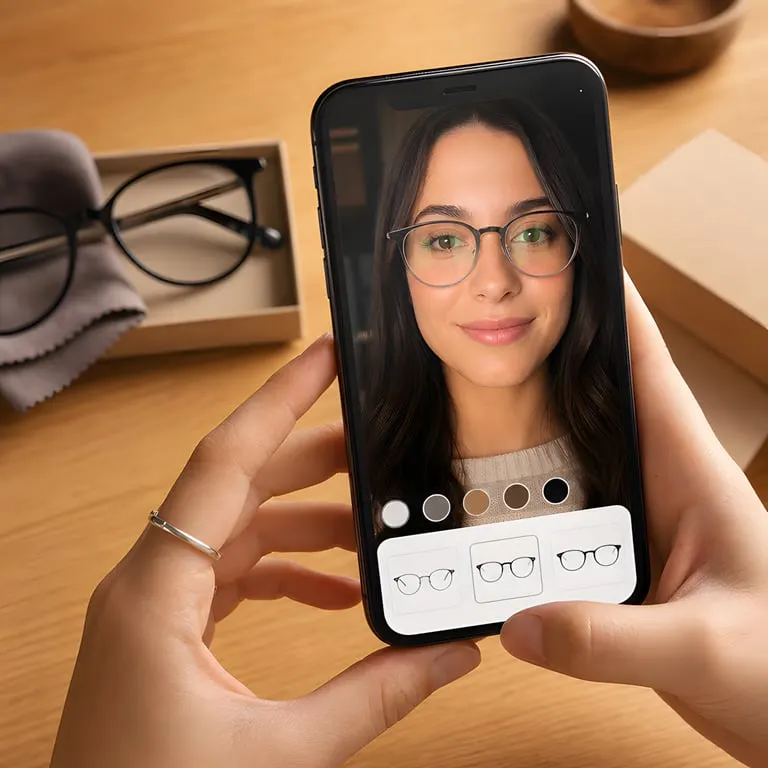
Once those standards are written, you have a rubric. You can measure your current workflow against it — and any technology decision too. A connected platform for discovery, try-on, measurement and order review, like Eyebrowse, is built to support several of these handoffs, especially the ones where information has to pass cleanly between a shopper, an optician and downstream fulfillment. But any tool's value depends on whether you've first defined what the handoff should feel like. Trained optical and clinical review stays at the center; the tools are there to remove the mechanical friction around it.
What to do this week
You don't need a project plan to get started. Three concrete steps:
- Choose one recent, typical patient visit and sketch the whole handoff chain on a single page. Arrows, not boxes.
- Circle the two handoffs where your team most often absorbs rework or where patients most often get confused. Those are your priorities.
- Write a one-sentence experience standard for each of those two handoffs and share it with the people on both sides of the arrow.
That's all. You'll have a clearer map than most practices work from, and you'll be in a far better position to judge the next workflow change — process, staffing or software — that lands on your desk.